Embarking on a camping adventure often means packing a significant amount of gear, and a roof box is an invaluable tool for expanding your vehicle’s storage capacity. However, simply stuffing everything inside can lead to serious safety risks, diminished vehicle performance, and potential damage to your equipment. Understanding the nuances of efficient and safe roof box packing is crucial for a stress-free journey, ensuring your camping trip starts and ends on a high note without the burden of an overloaded vehicle. This comprehensive guide will equip you with the expert knowledge to pack your roof box for camping intelligently, maximizing space while strictly adhering to safety protocols.
What is a Roof Box? Why You Need One for Camping
A roof box, also known as a cargo box or rooftop carrier, is an enclosed storage container mounted on your vehicle’s roof rack. Its primary function is to provide additional cargo space, freeing up valuable interior room for passengers and essentials you need quick access to. For campers, a roof box is particularly beneficial. It’s the perfect solution for transporting bulky yet lightweight camping equipment that might otherwise overcrowd your car’s trunk or passenger area.
Common camping scenarios that benefit from a roof box include family road trips with extensive gear, multi-day excursions requiring larger tents and sleeping systems, or even carrying specialized outdoor equipment like fishing rods or foldable chairs. The benefits are clear: increased carrying capacity means you don’t have to leave essential items behind. It also protects your gear from the elements, keeping it dry and clean, and secures your belongings, giving you peace of mind on long drives.
Understanding Your Roof Box and Vehicle Weight Limits
One of the most critical aspects of packing a roof box, especially for camping, is understanding and respecting weight limits. Overloading is a significant safety hazard that can compromise your vehicle’s stability, handling, and braking performance. It can also damage your roof box, roof rack, and even your vehicle’s roof structure.
First, you must identify two crucial weight capacities:
- Vehicle’s Roof Load Limit: This is the maximum weight your vehicle’s roof can safely support while in motion. This limit includes the weight of the roof rack system, the roof box itself, and all its contents. You can typically find this vital information in your vehicle’s owner’s manual, often under sections like “Weight Limit,” “Loading,” or “Specifications.” Vehicle dynamic roof limits usually range from 75 to 220 pounds (34 to 100 kg), varying significantly by make and model.
- Roof Box’s Maximum Load Capacity: Every roof box has a specific weight limit set by its manufacturer. This information is usually found in the product manual, on a sticker inside the box, or on the manufacturer’s website. Standard roof boxes typically hold between 75 to 165 pounds (34 to 75 kg).
Always use the lower of these two limits. If your vehicle has a 150 lb roof load limit and your roof box has a 165 lb capacity, your effective limit is 150 lbs. to subtract the weight of your roof rack and the empty roof box from this total to determine how much cargo you can actually pack. For example, if your car’s dynamic roof limit is 165 lbs and your roof rack system (bars + box) weighs 60 lbs, you can only pack 105 lbs of gear (165 – 60 = 105). Ignoring these limits can lead to serious accidents, so thorough checking is non-negotiable.
Choosing the Right Roof Box for Camping Gear
Selecting the appropriate roof box is the first step towards efficient and safe packing. Different types offer varying features that might suit your specific camping needs.
Roof Box Types by Material
|
Our Picks for the Best Roof Box in 2026
As an Amazon Associate I earn from qualifying purchases.
|
||
| Num | Product | Action |
|---|---|---|
| 1 | MIDABAO 20 Cubic Waterproof Duty Car Roof Top Carrier-Car Cargo Roof Top Bag, Waterproof & Coated Zippers includes Anti Slip Mat with or without Racks (20 Cubic Feet) |

|
| 2 | iBirdie Roof Rack Cargo Carrier 15.3 Cubic Feet, Soft-Shell Rooftop Cargo Box, Waterproof Heavy Duty 1200D for Car with/Without Roof Rack, Includes Anti-Slip Mat, Door Hooks, 46x34x17 inches |
|
| 3 | GarveeLife 46" x 36" Universal Roof Rack Cargo Carrier Basket, 200 Lbs Capacity Rooftop Cargo Rack, Car Top Luggage Holder Basket Heavy Duty for SUVs, Trucks, Vehicles |
|
| 4 | Pelican Cargo Cases |
|
| 5 | Asinking Car Rooftop Cargo Carrier Bag - 100% Waterproof Heavy Duty Car Roof Luggage Carrier 21 Cubic Feet, Fits All Vehicles with/Without Roof Rack - Easy Install & Triply Reinforced for Secure Use |
|
| 6 | FIVKLEMNZ 21 Cubic Car Rooftop Cargo Carrier Roof Bag Waterproof for All Top of Vehicle with/Without Rack Includes Topper Anti-Slip Mat + Reinforced Straps + 6 Door Hooks + Luggage Lock |
|
| 7 | iBirdie Roof Rack Cargo Carrier 32.1 Cubic Feet, XXL Soft-Shell Rooftop Cargo Box, Waterproof Heavy Duty 1200D for Car with/Without Roof Rack, Includes Anti-Slip Mat, Door Hooks, 60x37x25 inches |
|
| 8 | Sailnovo Rooftop Cargo Carrier Roof Bag, 20 Cubic feet Waterproof Roof Cargo Carrier fit car with/Without Luggage Rack - Vehicle Soft Shell Roof Cargo Box with Tie-Down Strap, Safety Hook |
|
| 9 | MeeFar Roof Rack Carrier Basket Universal Rooftop 51" X 36" X 5" + Waterproof Bag 15 Cubic Feet (44" 34" 17"), and Cargo Net with Attachment Hooks, Ratchet Straps |
|
| 10 | Car Rooftop Cargo Carrier Bag, 21 Cubic Feet 100% Waterproof Heavy Duty 840D Car Roof Bag for All Vehicle with/Without Racks - Anti-Slip Mat, 6 Door Hooks, Storage Bags, 2 Extra Straps, Luggage Lock |
|
The material of your roof box plays a role in its durability, weight, and price point.
- ABS Plastic: This is the most common material due to its balance of durability, flexibility, and affordability. ABS plastic boxes are lightweight, impact-resistant, and offer good protection against weather. They are suitable for most camping needs.
- Fiberglass: Fiberglass boxes tend to be more rigid, often lighter, and can have a more premium finish. They offer excellent durability and weather resistance but usually come at a higher price.
- Metal: Less common for passenger vehicles, metal roof boxes are extremely durable and secure but are significantly heavier, which can quickly eat into your vehicle’s load capacity. They are generally reserved for heavy-duty commercial or off-road applications.
Roof Box Types by Size and Volume
Roof boxes come in various lengths, widths, and heights, determining their overall volume (capacity).
- Small (8-12 cubic feet / 220-340 liters): Best for minimal extra gear, such as a couple of sleeping bags and a small tent.
- Medium (13-16 cubic feet / 370-450 liters): A popular choice for families, accommodating several sleeping bags, a larger tent, and some soft luggage.
- Large (17-22+ cubic feet / 480-620+ liters): Ideal for extensive camping trips, offering space for bulky items like large tents, multiple sleeping systems, camp chairs, and other oversized gear.
When choosing, consider what specific items you plan to carry and ensure the box dimensions can accommodate them (e.g., long tents or fishing rods). a bigger box isn’t always better if it leads to exceeding your vehicle’s weight limit or creates excessive drag.
Roof Box Types by Design and Features
Modern roof boxes incorporate various design elements for convenience, security, and performance.
- Aerodynamic Design: Streamlined shapes reduce wind resistance, minimizing noise and improving fuel efficiency. This is particularly important for long camping trips.
- Dual-Side Opening: Allows access to your gear from either side of the vehicle, making loading and unloading much easier, especially in tight camping spots.
- Security Features: Integrated locking systems are standard, but look for robust latches and multiple locking points to secure your valuable camping equipment.
- Quick-Mount Systems: Tool-free mounting hardware makes installation and removal simple and fast, a great convenience for frequent campers.
Strategic Packing for Camping: Maximizing Space and Safety
Efficient packing is an art that balances maximizing space with critical safety considerations, primarily weight distribution.
Prioritize What Goes Where
A fundamental rule for roof box packing is to differentiate between heavy and light items.
- Roof Box (Bulky but Lightweight): The roof box is best suited for items that take up a lot of space but don’t add much weight. Think sleeping bags, sleeping pads, tents, camp chairs, pillows, soft duffel bags with clothes, and perhaps lightweight cooking gear. These items help fill the volume without approaching weight limits.
- Inside the Car (Heavy Items): Keep heavy items inside your vehicle, ideally in the trunk or on the floor of the back seat. This includes items like coolers (especially when full), water jugs, heavy toolboxes, or large bins of dry food. Keeping weight low and centered within the car significantly improves vehicle stability and handling.
Optimal Weight Distribution
Proper weight distribution is paramount for safe driving. Poorly distributed weight can lead to a dangerously high center of gravity, affecting steering, braking, and making your vehicle prone to swaying, especially in crosswinds or during emergency maneuvers.
- Center the Heaviest Items: Place the heaviest permissible items in the middle of the roof box, directly over your vehicle’s crossbars. This helps keep the weight concentrated over the strongest part of your roof rack system and maintains your vehicle’s balance.
- The 60/40 Rule: A good guideline is to aim for approximately 60% of the roof box’s total weight to be positioned in the central section (between the crossbars), with the remaining 40% split evenly between the front and back sections.
- Evenly Distributed: Ensure weight is spread evenly from side to side and front to back. Avoid stacking all heavy items on one side or at one end, which can create imbalance and unpredictable handling.
Efficient Packing Techniques
Beyond weight distribution, smart packing techniques help you make the most of every inch inside your roof box.
- Use Soft Bags and Compression Sacks: Ditch rigid suitcases. Soft duffel bags, packing cubes, and compression sacks are your best friends. They are flexible, allowing you to mold them around irregular shapes and fill voids effectively. Compression sacks are excellent for sleeping bags and bulky clothing, shrinking them to a fraction of their size.
- Fill Gaps and Voids: Any empty space allows items to shift, which can be noisy and potentially damage your gear or the roof box. Use smaller, soft items like towels, jackets, or extra clothing to fill these gaps, creating a snug, secure load.
- Layering Strategy: Start with flatter, heavier items (like a folded tent) at the bottom, in the center. Then, layer medium-sized items, followed by smaller, lighter, and more irregularly shaped items on top.
- Protect Fragile Items: If you must carry fragile items, wrap them thoroughly in soft clothes, blankets, or sleeping bags. Place them securely in the center of the box, cushioned by other soft items, ensuring they don’t press against the sides or lid.
- Disassemble Larger Items: If possible, disassemble larger camping gear. For example, remove poles from tents and pack them separately, or flatten foldable furniture.
Securing Your Load
Once everything is packed, securing the load prevents movement during transit. Many roof boxes come with internal straps or tie-down points.
- Utilize Internal Straps: Always use the integrated straps or bungee cords to tie down your packed gear. This prevents items from shifting forward during braking, backward during acceleration, or side-to-side on turns, maintaining weight distribution and preventing damage.
- Snug Fit: Ensure the load is packed snugly, with minimal room for movement. If there are still large voids after packing, consider if those items could be placed elsewhere or if you have smaller items to fill the space.
Step-by-Step Guide to Loading Your Roof Box for Camping
Follow these steps for a safe and organized camping trip:
- Prepare Your Gear: Lay out all the camping gear you intend to pack. Separate bulky, lightweight items for the roof box from heavier items for the car’s interior. If possible, weigh individual items to get an idea of your total load.
- Install Roof Bars and Box: Ensure your roof rack system (crossbars) is securely installed according to manufacturer instructions. Attach the roof box firmly to the crossbars using its quick-mount or U-bolt system. Double-check all connections.
- Place Heavy Items in the Center: Start by placing the heaviest permissible items (bulky but not excessively heavy, like a large tent or thick sleeping bags) directly over the vehicle’s crossbars, in the center of the box.
- Distribute Lighter Items: Arrange lighter and softer items around the central heavier load. Spread them evenly towards the front, back, and sides, aiming for balanced weight distribution.
- Fill Voids: Use smaller items, clothing, towels, or blankets to fill any remaining gaps. This prevents items from shifting during your journey.
- Secure All Items: Use the internal straps, cargo nets, or bungee cords to firmly secure the entire load within the roof box. Make sure everything is compressed and cannot move freely.
- Close and Lock: Gently press down on the lid to ensure it closes completely and latches securely. Never force the lid shut; if it doesn’t close easily, repack. Lock the roof box with the key to prevent accidental opening and theft.
- Pre-Drive Checks: Before setting off, perform a final inspection. Wiggle the roof box to ensure it’s firmly attached to the roof bars. Check that no part of the load obstructs your view or vehicle lights.
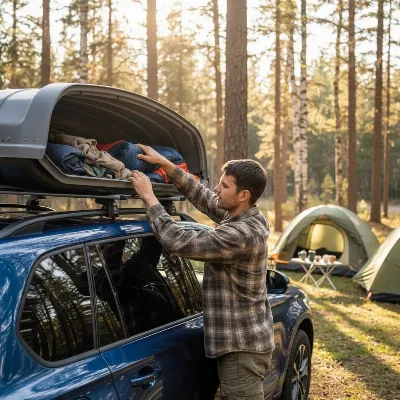 A person carefully arranging soft camping gear into a grey roof box mounted on a car, ensuring even weight distribution. The car is parked outdoors at a campsite during the day.
Driving Safely with a Loaded Roof Box
Driving with a loaded roof box changes your vehicle’s dynamics significantly. The added weight and increased height raise your vehicle’s center of gravity, affecting stability and handling.
- Adjust Your Speed: Always reduce your speed, especially on highways, winding roads, and in adverse weather conditions (strong winds, rain). Excessive speed amplifies the impact of crosswinds and sudden maneuvers.
- Increase Following Distance: Your braking distance will be longer due to the added weight. Maintain a greater distance from the vehicle in front of you to allow for more reaction time.
- Take Turns Slowly: Cornering will feel different. Reduce speed before entering turns and navigate them smoothly to prevent sway and maintain control.
- Be Aware of Crosswinds: High winds can significantly affect a vehicle with a roof box, making it feel unstable. Drive cautiously and anticipate lateral forces.
- Avoid Sudden Maneuvers: Rapid acceleration, sudden braking, or sharp turns can destabilize your vehicle and cause the load to shift inside the roof box, potentially leading to damage or loss of control.
- Check Clearance: Be mindful of your vehicle’s increased height. Watch out for low overhangs, garage entrances, car park barriers, and tree branches, especially when entering campsites.
- Regular Checks: During longer journeys, stop periodically (e.g., during fuel stops) to check that the roof box is still securely attached, and the contents haven’t shifted.
Roof Box Care and Maintenance for Campers
Proper care extends the lifespan of your roof box and ensures its reliability for future camping trips.
- Post-Trip Cleaning: After each camping adventure, empty the roof box and clean it thoroughly, inside and out. Remove any dirt, dust, or debris. Use mild soap and water, then rinse and dry completely to prevent mold or mildew growth.
- Inspect for Damage: Check for any cracks, dents, or signs of wear on the box, hinges, latches, and mounting hardware. Address any issues promptly. Lubricate locks if they feel stiff.
- Proper Storage: When not in use, store your roof box in a cool, dry place, away from direct sunlight, which can degrade plastics over time. Many people hang their roof boxes in a garage using specialized hoists or store them vertically to save space.
- Maintain Roof Rack: Also, inspect your vehicle’s roof rack system for any loose bolts, corrosion, or damage, as its integrity is crucial for safe roof box use.
Conclusion
Packing a roof box for camping without overloading is more than just fitting everything in; it’s about ensuring safety, optimizing your vehicle’s performance, and enhancing your overall outdoor experience. By understanding the critical weight limits of both your vehicle and your roof box, strategically distributing weight, and employing smart packing techniques with lightweight, bulky items, you can embark on your adventures with confidence. to prioritize safety, adjust your driving style, and perform regular checks. A well-packed roof box is a major upgrade for any camper, transforming a potentially cramped and stressful journey into a comfortable and enjoyable part of your outdoor escape.
What essential camping gear do you find makes the biggest difference when packing your roof box efficiently?
Frequently Asked Questions
How do I know my roof box and car’s weight limit?
You can find your car’s dynamic roof load limit in its owner’s manual. The roof box’s weight limit is usually in its product manual or on a sticker inside the box. Always use the lower of these two limits, and to subtract the weight of your roof rack and the empty roof box from the total permissible load.
What types of items should I avoid putting in a roof box?
Avoid placing heavy items like full coolers, large water jugs, heavy toolboxes, or dense food bins in your roof box. These should be stored inside your vehicle to maintain a lower center of gravity. Also, avoid extremely fragile items, as roof boxes are not designed for maximum impact protection.
How does a roof box affect my car’s fuel efficiency?
A roof box increases aerodynamic drag, which can lead to a noticeable decrease in fuel efficiency. The impact varies depending on the box’s design, your driving speed, and wind conditions. Aerodynamically designed boxes help minimize this effect, but driving at lower speeds is the most effective way to reduce fuel consumption.
Is it safe to drive at highway speeds with a roof box?
While roof boxes are designed for highway use, it’s generally recommended to reduce your speed compared to driving without one. The increased height and weight can affect handling, especially in crosswinds or during sudden maneuvers. Always drive cautiously and below the maximum speed limits specified by your roof box or vehicle manufacturer.
Can I put a rooftop tent on the same roof rack as a roof box?
The primary concern is the total weight on your roof rack system. While some larger roof racks might support both, it’s highly unlikely you would stay within your vehicle’s dynamic roof load limit. Rooftop tents themselves are heavy, and adding a loaded roof box would almost certainly lead to dangerous overloading. It’s best to use a roof box or a rooftop tent, but generally not both simultaneously on the same vehicle roof.
Get our weekly buyer guide
Practical specs, not advice. Unsubscribe anytime.
