Narrow roof boxes are an indispensable accessory for kayakers, providing essential enclosed storage for gear while leaving sufficient space on vehicle roof bars to mount a kayak alongside. These specialized cargo carriers, typically under 26 inches (65 cm) wide, allow outdoor enthusiasts to transport paddles, life vests, dry bags, and camping equipment securely on the roof, freeing up crucial interior vehicle space. This guide explores the benefits, types, and top five narrow roof boxes for kayak combos, ensuring convenience and organization for your next adventure.
What is a Roof Box? Why Do You Need One, Especially for Kayak Combos?
A roof box, also known as a rooftop cargo carrier, is an enclosed storage unit mounted on your vehicle’s roof rack. Its primary function is to expand your car’s carrying capacity, protecting your belongings from the elements and freeing up interior space. For adventurers who regularly hit the road with their kayaks, the utility of a roof box transforms from a mere convenience to a necessity.
Imagine packing for a weekend kayaking and camping trip. Besides your kayak, you need dry clothes, a tent, sleeping bags, cooking gear, and safety equipment. Without a roof box, your car’s trunk and back seats quickly become overwhelmed. This is where a narrow roof box shines, allowing you to transport all your bulky, lightweight gear securely on the roof while keeping the car’s interior clear and comfortable for passengers. Specifically designed to leave sufficient room on your roof bars, a narrow roof box ensures you can easily fit a kayak carrier right next to it. This combination is ideal for various scenarios, from long-distance road trips to local lake excursions, providing peace of mind that your gear is safe, organized, and out of the way.
Popular Types of Roof Boxes on the Market
The market offers a diverse range of roof boxes, but for those balancing gear with a kayak, focusing on narrow variants is key. Understanding the different characteristics, such as material, size, and design, will help you select the perfect companion for your kayaking escapades.
Roof Boxes by Material
The construction material of a roof box significantly impacts its durability, weight, and overall performance. The two primary materials used are ABS plastic and fiberglass.
-
ABS Plastic (Acrylonitrile Butadiene Styrene): This thermoplastic polymer is a popular choice due to its excellent impact resistance, lightweight nature, and cost-effectiveness. ABS plastic roof boxes are generally lighter, which contributes to better fuel efficiency and makes them easier to install and remove. They are also known for good UV protection and can be molded into sleek, aerodynamic shapes. Modern ABS plastics are designed to withstand varying temperatures, though some older or lower-quality versions might become stiffer in extreme cold. Another advantage is that ABS is often recyclable at the end of its life, making it a more environmentally friendly option compared to some composites.
-
Fiberglass: Roof boxes made from fiberglass (fiberglass-reinforced polyester) are celebrated for their superior robustness, extreme durability, and high crash safety ratings. This material offers greater rigidity and can typically handle heavier loads, provided your vehicle’s roof and crossbars are rated for it. Fiberglass also exhibits more flexibility than ABS without cracking, which can be an advantage in certain stress situations. However, fiberglass boxes are generally heavier and more expensive. The manufacturing process for fiberglass can be harsher on the environment, and recycling them is more challenging than ABS.
Roof Boxes by Size and Capacity
|
Our Picks for the Best Roof Box in 2026
As an Amazon Associate I earn from qualifying purchases.
|
||
| Num | Product | Action |
|---|---|---|
| 1 | iBirdie Roof Rack Cargo Carrier 32.1 Cubic Feet, XXL Soft-Shell Rooftop Cargo Box, Waterproof Heavy Duty 1200D for Car with/Without Roof Rack, Includes Anti-Slip Mat, Door Hooks, 60x37x25 inches |

|
| 2 | Car Rooftop Cargo Carrier Bag, 21 Cubic Feet 100% Waterproof Heavy Duty 840D Car Roof Bag for All Vehicle with/Without Racks - Anti-Slip Mat, 6 Door Hooks, Storage Bags, 2 Extra Straps, Luggage Lock |
|
| 3 | GarveeLife 46" x 36" Universal Roof Rack Cargo Carrier Basket, 200 Lbs Capacity Rooftop Cargo Rack, Car Top Luggage Holder Basket Heavy Duty for SUVs, Trucks, Vehicles |
|
| 4 | iBirdie Roof Rack Cargo Carrier 15.3 Cubic Feet, Soft-Shell Rooftop Cargo Box, Waterproof Heavy Duty 1200D for Car with/Without Roof Rack, Includes Anti-Slip Mat, Door Hooks, 46x34x17 inches |
|
| 5 | FIVKLEMNZ 21 Cubic Car Rooftop Cargo Carrier Roof Bag Waterproof for All Top of Vehicle with/Without Rack Includes Topper Anti-Slip Mat + Reinforced Straps + 6 Door Hooks + Luggage Lock |
|
| 6 | MeeFar Roof Rack Carrier Basket Universal Rooftop 51" X 36" X 5" + Waterproof Bag 15 Cubic Feet (44" 34" 17"), and Cargo Net with Attachment Hooks, Ratchet Straps |
|
| 7 | Pelican Cargo Cases |
|
| 8 | Asinking Car Rooftop Cargo Carrier Bag - 100% Waterproof Heavy Duty Car Roof Luggage Carrier 21 Cubic Feet, Fits All Vehicles with/Without Roof Rack - Easy Install & Triply Reinforced for Secure Use |
|
| 9 | Sailnovo Rooftop Cargo Carrier Roof Bag, 20 Cubic feet Waterproof Roof Cargo Carrier fit car with/Without Luggage Rack - Vehicle Soft Shell Roof Cargo Box with Tie-Down Strap, Safety Hook |
|
| 10 | MIDABAO 20 Cubic Waterproof Duty Car Roof Top Carrier-Car Cargo Roof Top Bag, Waterproof & Coated Zippers includes Anti Slip Mat with or without Racks (20 Cubic Feet) |
|
When combining a roof box with a kayak, the box’s dimensions are paramount. You need a model that’s long enough for your gear but critically narrow enough to leave room on your crossbars.
- Narrow Dimensions: Look for roof boxes typically under 26 inches (approximately 65 cm) wide. This slim profile is essential for accommodating a kayak carrier, such as J-cradles or stackers, alongside the box on standard roof bars.
- Common Capacities: Narrow boxes usually range from 10 to 16 cubic feet (approximately 280 to 450 liters). While seemingly smaller, this capacity is often sufficient for paddles, life vests, dry bags, camping essentials, and other soft goods, keeping them protected and organized.
- Length for Gear: Many narrow boxes are also quite long, often exceeding 70 inches (180 cm). This length is beneficial for stowing elongated items like tent poles, fishing rods, or even disassembled kayak paddles, ensuring all your gear fits without compromising width.
Roof Boxes by Style and Design
Beyond material and size, the style and design of a narrow roof box contribute to its functionality and aesthetics.
- Aerodynamic Designs: Modern narrow roof boxes often feature streamlined, aerodynamic shapes. This design is crucial for minimizing wind resistance, which in turn reduces wind noise during travel and helps improve fuel efficiency—an important consideration when carrying extra gear.
- Convenient Features:
- Dual-Side Opening: This feature allows you to open the box from either the driver’s or passenger’s side of the vehicle, making loading and unloading significantly easier, especially when navigating tight spaces or reaching items from either side of your kayak.
- Quick-Mount Systems: Tool-free, quick-release mounting systems, often with torque-limiting mechanisms, simplify installation and removal. These systems ensure the box is securely fastened to your crossbars without overtightening.
- Security Locks: Integrated locking mechanisms, often centralized, provide peace of mind by securing your belongings inside the box and locking the box to your roof rack, deterring theft.
 Sleek narrow roof box alongside a kayak on an SUV, adventurous backdrop.
Comparison Table: Top Narrow Roof Boxes for Kayak Combos
When choosing a narrow roof box to complement your kayak, several models stand out for their design, features, and suitability. Here’s a comparison of some of the best options available:
| Model | Capacity (Cu Ft / Liters) | Dimensions (L x W x H) | Material | Key Features | Pros | Cons |
|---|---|---|---|---|---|---|
| Yakima SkyBox NX12 | 12 cu ft / 340 L | 89 x 24 x 16 in (226 x 61 x 41 cm) | ABS Plastic | Sleek design, easy installation, dual-side opening, internal tie-downs | Excellent narrow profile for kayak combos, durable carbonite texture, user-friendly. | Slightly smaller capacity than some wider options. |
| Thule Force XT Sport | 11 cu ft / 310 L | 74.8 x 24.8 x 16.7 in (190 x 63 x 42 cm) | ABS Plastic | PowerClick quick-mount system, dual-side opening, aerodynamic design | Very narrow, good for bikes/kayaks, easy to install, quiet operation. | Capacity might be tight for very bulky items. |
| Thule Motion XT Sport | 15 cu ft / 425 L | 77 x 25.6 x 16.5 in (196 x 65 x 42 cm) | ABS Plastic | PowerClick quick-mount, SlideLock system, dual-side opening, wider interior | More internal volume for its narrow profile, premium feel, robust. | Higher price point. |
| Inno Wedge 660 | 11 cu ft / 310 L | 80 x 27.5 x 11 in (203 x 70 x 28 cm) | ABS Plastic | Low-profile, contoured shape, memory mount system, dual-side opening | Sleek, minimal wind noise, good for vehicles with rear antennas, aerodynamic. | Slightly wider than other “narrow” options, potentially tighter for some kayaks. |
| Thule Pulse Alpine | 11 cu ft / 310 L | 88.5 x 25.5 x 12.5 in (225 x 65 x 32 cm) | ABS Plastic | Quick-grip mounting, passenger-side opening, rugged textured finish | Very narrow (25.5 in), long for skis/paddles, excellent for fitting next to kayak racks, budget-friendly. | Only single-side opening (passenger side). |
Note: Dimensions and capacities are approximate and can vary slightly by specific model year or regional variations.
How to Choose the Right Narrow Roof Box (Buying Guide)
Selecting the ideal narrow roof box requires careful consideration to ensure it perfectly integrates with your vehicle, your kayak, and your adventure style.
Determine Your Usage Needs
Start by evaluating what you plan to store. Are you carrying multiple kayak paddles, life jackets, and dry bags for a group, or just personal camping gear for a solo trip? This will guide your decision on the required capacity and length. Critically, confirm you need to carry a kayak simultaneously. This instantly narrows your options to slimmer boxes that leave sufficient space on your crossbars. Think about the bulk, not just the weight, of your items. Soft goods like sleeping bags compress well, while hard cases or fishing tackle boxes need solid dimensions.
Choose Material and Size Suitable for Your Vehicle and Kayak
The right fit ensures safety and optimal performance. First, consult your vehicle’s owner’s manual for its maximum roof load capacity; never exceed this limit. Then, measure your roof rack’s crossbar spread. For narrow boxes, it’s crucial to measure the available width on your crossbars once your kayak carrier is installed or accounted for. A standard kayak might take up 24-30 inches, meaning you’ll need a roof box that’s roughly 20-26 inches wide to fit alongside.
Also, consider the roof box’s length relative to your vehicle’s roof. While a longer box can carry more gear, it must not interfere with your rear hatch opening or significantly overhang your windshield. Material-wise, if you prioritize impact resistance and a lighter footprint for better fuel economy, ABS is an excellent choice. If extreme durability and higher load capacity are paramount, and you don’t mind the extra weight and cost, fiberglass might be suitable, though less common for narrow designs.
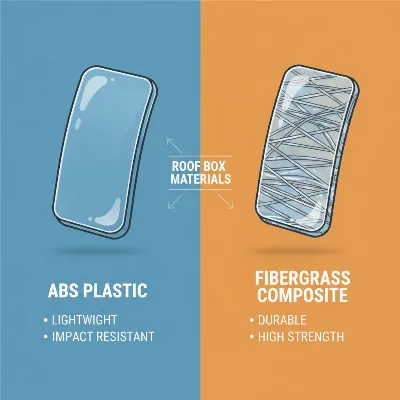 Illustrative comparison of ABS vs Fiberglass for roof boxes
Consider Convenient Features
Modern roof boxes come equipped with features designed to enhance usability and security. Dual-side opening is a major upgrade, allowing access from either side of your vehicle, which is particularly useful when you have a kayak mounted on one side. Quick-mount systems simplify installation, often with audible clicks indicating proper tightening, saving you time and effort. Integrated locking systems provide peace of mind by securing your valuables and fastening the box to your roof rack. Some boxes also feature internal tie-down points to keep gear from shifting during transit, and aerodynamic profiles can dramatically reduce wind noise and drag, making long drives more pleasant.
Research Brands and User Reviews
Leading brands like Thule and Yakima dominate the roof box market for good reason, offering a wide range of reliable and well-engineered products. Inno also provides competitive options. Look for specific models renowned for their narrow design and positive feedback from users who also carry kayaks or other sporting equipment. User reviews often offer invaluable insights into real-world performance, ease of installation, durability, and any potential issues with hatch clearance or wind noise. Pay attention to reviews that mention use in similar vehicle types or with similar gear setups to yours.
Compare Prices and Find Reputable Sellers
Roof boxes represent a significant investment, so comparing prices from various retailers is wise. Online outdoor gear specialists, automotive accessory stores, and direct brand websites are good places to start. Look for authorized dealers who offer robust warranties and good customer service. While it might be tempting to opt for the cheapest option, that quality and durability often correlate with price. Investing in a reputable brand with strong reviews typically ensures better long-term value, superior protection for your gear, and a safer experience on the road.
Safe Installation and Use of Your Narrow Roof Box
Proper installation and usage are crucial for the safety of your gear, your vehicle, and others on the road. Even the best narrow roof box requires correct handling.
Begin by ensuring your vehicle’s roof rack (crossbars and towers) is correctly installed and securely fastened according to the manufacturer’s instructions. Always position the roof box centrally on the crossbars, ensuring it does not interfere with the rear hatch opening when fully raised. Most modern roof boxes feature quick-mount systems with integrated torque indicators, such as a knob that clicks when tightened sufficiently. Follow these instructions precisely to secure the box firmly without overtightening. Before embarking on your journey, give the box a firm shake to confirm it’s stable and re-check all mounting hardware after a few miles of driving, as vibrations can sometimes cause initial loosening.
When loading your narrow roof box, distribute weight evenly. Place heavier items toward the center of the box and directly over your vehicle’s crossbars to maintain stability. Secure all loose items inside the box using internal tie-down straps or cargo nets to prevent shifting, which can cause damage to your gear or the box itself, and can also impact your vehicle’s handling. Always adhere to the maximum load capacity specified by both the roof box and your vehicle manufacturer; never exceed the lower of the two limits. Regularly inspect your roof box for any signs of wear, damage, or loose components, especially before long trips, to ensure continued safe operation.
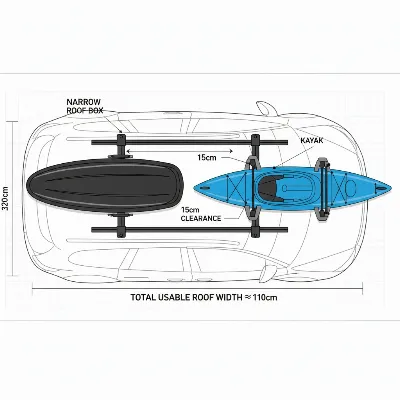 Diagram illustrating narrow roof box and kayak on car roof bars
Important Considerations When Using a Roof Box with a Kayak
Combining a roof box with a kayak on your vehicle’s roof introduces several unique considerations you must be aware of to ensure a smooth and safe journey.
Firstly, be mindful of speed limits and driving dynamics. The added weight and aerodynamic drag from both the roof box and kayak will affect your vehicle’s handling, braking, and fuel efficiency. Drive at reduced speeds, especially in windy conditions or on uneven terrain. Avoid sudden maneuvers, as the higher center of gravity can increase sway and reduce stability.
Secondly, always be acutely aware of your vehicle’s overall height. With a roof box and kayak stacked on top, your vehicle will be significantly taller than usual. This is critical when entering garages, carports, drive-thrus, or passing under low bridges and overhangs. Many experienced users attach a reminder to their dashboard to prevent accidental collisions.
Thirdly, perform a thorough pre-trip inspection. Before every journey, especially after loading, double-check that both your roof box and kayak carriers are securely fastened to the crossbars. Ensure all straps on the kayak are tight, and the roof box lid is properly closed and locked. Loose gear or an unsecured box can pose serious hazards.
Finally, consider wind noise and fuel efficiency. While aerodynamic designs help, carrying items on the roof will inevitably increase drag and wind noise compared to driving without them. This will typically result in a noticeable reduction in fuel economy. Plan your trips accordingly, and factor in potential extra fuel costs. Some drivers find that removing the roof box when not in use helps mitigate these effects.
“For avid kayakers, a narrow roof box isn’t just about storage; it’s about expanding your adventure horizon without sacrificing convenience or safety. The key is balance—both on your roof and in your planning.” – Alex Chen, Outdoor Gear Specialist at Reviewutible.com
Conclusion
For the dedicated kayaker, a narrow roof box is an ingenious solution, seamlessly blending extra storage capacity with the ability to transport your kayak. It addresses the common challenge of limited vehicle space, ensuring all your essential gear is protected, organized, and out of the way, leaving your vehicle’s interior clear for passengers and comfort. From road trips to quick paddles, selecting the right narrow roof box transforms your journey into a more efficient and enjoyable experience. By considering material durability, appropriate size for your vehicle and kayak, convenient features like dual-side opening, and trusted brands, you can confidently choose a model that meets your adventurous needs.
Prioritizing safe installation and being mindful of your vehicle’s altered driving dynamics and height are paramount for peace of mind on the road. A narrow roof box is more than just an accessory; it’s an investment in smoother, more organized, and ultimately more frequent outdoor escapades. Ready to enhance your next kayaking adventure? Which narrow roof box will join you on your next journey, making every trip to the water effortless and exciting?
Frequently Asked Questions
Choose the Right Narrow Roof Box for Kayak Combos
Selecting the ideal narrow roof box requires careful consideration to ensure it perfectly integrates with your vehicle, your kayak, and your adventure style.
Evaluate what gear you plan to store, such as paddles, life jackets, or camping equipment. Confirm you need to carry a kayak simultaneously, which will narrow your options to slimmer boxes that leave sufficient space on your crossbars. Consider the bulk and weight of your items to guide capacity and length decisions.
Consult your vehicle's owner's manual for its maximum roof load capacity and measure your roof rack's available width once your kayak carrier is accounted for. Look for boxes under 26 inches wide. Prioritize ABS plastic for impact resistance and lighter weight, or fiberglass for extreme durability if load capacity is paramount.
Look for features like dual-side opening for easy access, quick-mount systems for simplified installation, and integrated security locks for peace of mind. Internal tie-down points prevent gear shifting, and aerodynamic profiles reduce wind noise and improve fuel efficiency during travel.
Investigate leading brands like Thule, Yakima, and Inno, known for reliable products. Seek out specific models with narrow designs and positive feedback from users who also transport kayaks. User reviews offer valuable insights into real-world performance, ease of installation, and potential issues.
Compare prices from various authorized retailers, including online outdoor gear specialists and direct brand websites. While cost is a factor, prioritize quality and durability. Investing in a reputable brand with strong reviews typically ensures better long-term value and a safer experience on the road.
Get our weekly buyer guide
Practical specs, not advice. Unsubscribe anytime.

I’ve been looking for a solution to carry my kayak and all my gear without cramming everything inside my SUV. The Thule Pulse Alpine mentioned here is exactly what I needed. It’s narrow enough to fit perfectly next to my kayak mounts, and I can finally store my paddles and life vests securely. Installation was a breeze too, which was a pleasant surprise.
I appreciate the focus on narrow roof boxes for kayak combos, as that’s exactly my use case. I picked up a budget-friendly option, not one of the top five, but similar to the ‘under 26 inches wide’ spec. While it does the job for my fishing gear, I’ve noticed it’s a bit noisy at highway speeds compared to what I expected. Next time, I might invest in one of the more premium brands for better aerodynamics.
Finally, a way to keep my car interior clean and clear when heading to the lake! The concept of freeing up crucial interior vehicle space really resonated with me. I chose the Inno Wedge 660 and it’s fantastic. It’s sleek, doesn’t add much drag, and holds all my kayaking accessories, from my spray skirt to my water shoes. Highly recommend for anyone with a small car and a big hobby.
This guide was super helpful in narrowing down options. I ended up going with one of the Yakima models, the SkyBox 12 Carbonite, and it’s been great for weekend trips. It holds a surprising amount of stuff for its size, keeping my dry bags and camping essentials safe from the weather. My only minor complaint is that the latch can be a little stiff sometimes, but it’s a small trade-off for the extra space.